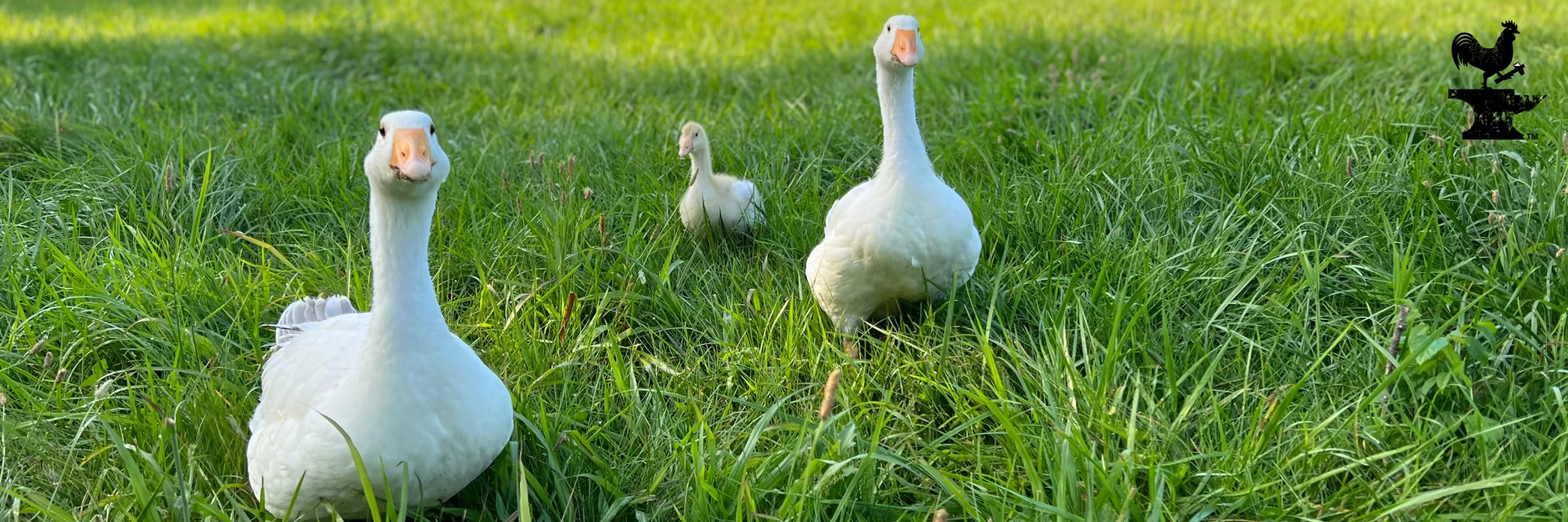
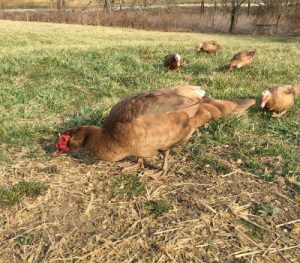
 LaRue, our Leghorn rooster, will call the hens over with a special cluck when he finds a tasty treat while foraging. He lets the girls eat first, so when we’re tossing bread to them (an occasional treat), he doesn’t usually get to eat much of it. Not so for the leader of the ducks, Tiberius.
We flipped over some pavers that have been filling a puddle and there were lots of worms under there. The chickens ran over when they realized what was going on, as did Ty and his girls. The chickens pulled up quite a few of the worms, but the ducks were deadeyes. Their bills seem particularly well-suited to pulling the worms from the soil in one piece; pulling them out with fingers can cause them to tear in half. Ty, in particular, gobbled up some of the biggest and juiciest-looking ones. Did he call the ducks over to share the bounty? Nope. He just ate as many as he saw.
While he’s clearly not a gentleman when it comes to food, maybe that’s because he’s nearly twice the ducks’ size and therefore needs to find a lot of food to stay in fighting shape. He does a good job keeping the ducks safe and he even chases LaRue off from time to time. We haven’t lost any of the ducks since their wings were clipped last year, and we hope they continue to stay safe under Ty’s watchful guard.
 The bugs are here. Tiny gnats, big flies, spiders, moths, even small grasshoppers – the bugs have reappeared after winter’s retreat. Well, maybe winter hasn’t fully retreated yet – there’s snow in the forecast for next Sunday…but it’s also supposed to be 48 degrees. The emergence of bugs means the chickens and ducks will eat as many creeping, crawling creatures as they can catch, and be less reliant on their premade feed. The ducks are worm, tick, and fly-eating machines, too. It’s in their nature: ducks and chickens are omnivorous, and bugs are a great protein source.
 The kits can now exit and enter the nest boxes at will, and are typically out of the boxes in the morning. In just a few days, we’ll remove the nest boxes entirely. That means the poor does won’t have respite from the always-hungry kits, and those youngsters are relentless.
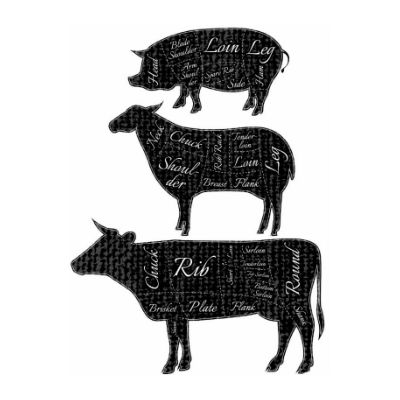 The PRIME (Processing Revival and Intrastate Meat Exemption) Act is a step toward allowing consumers to obtain the food of their choosing right from the source; specifically, meat. Currently, in order for small farmers to sell poultry (for example) to consumers, it must be processed at a USDA-inspected slaughterhouse. This creates stress on the animals often being transported long distances to the facility; additional costs for the farmer; and removes the farmer’s ability to employ the most low-stress, humane slaughter method.