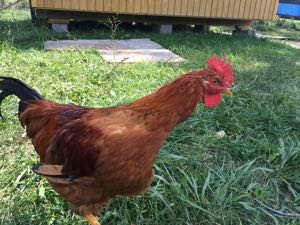
 Farmers face ethical dilemmas, like what to do when you end up with more roosters than you need. When hatching eggs, you can typically expect there to be a ratio of roughly 50% males and 50% females. We need laying hens to supply our eggs, but a ratio of one rooster to up to ten hens is all that’s needed for fertile eggs and protection.
The first batch of eggs resulted in 22 viable chicks, so the odds are that as many as 11 of those could be roosters. Adding those 22 to the 7 remaining adult chickens means there would be a total of 29 chickens, with one adult rooster and possibly 11 juveniles. Clearly, that’s too many roosters, which can result in rooster injuries from dominance-related fighting and hen injuries due to overbreeding. So what do we plan to do?
 It’s snowing – lightly now, but it’s supposed to pick up this evening. There’s a very chilly breeze, which is the really unpleasant part; spend any time out there without a balaclava, and you’ll be sorry.
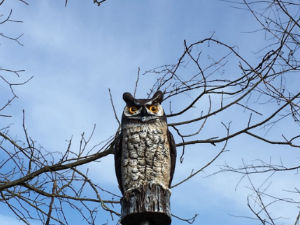 We spent the weekend putting up hawk deterrents to try to discourage the hawk from continuing to attack our chickens. The reflective mylar tape was very flashy with its prismatic print, and we cut “tails” into it to make it even more annoying and distracting. The tape lengths we tied onto the lines rustled and spun in the breeze. We also added DVDs tied onto lines throughout the streambed area, and they spun and flashed, too. Finally, the glowering owl was added on a tall pole. Hopefully, it sends the message “hawks stay away”!