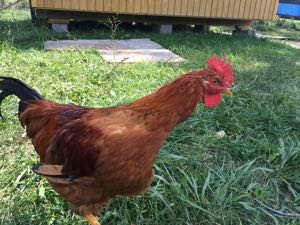
 Farmers face ethical dilemmas, like what to do when you end up with more roosters than you need. When hatching eggs, you can typically expect there to be a ratio of roughly 50% males and 50% females. We need laying hens to supply our eggs, but a ratio of one rooster to up to ten hens is all that’s needed for fertile eggs and protection.
The first batch of eggs resulted in 22 viable chicks, so the odds are that as many as 11 of those could be roosters. Adding those 22 to the 7 remaining adult chickens means there would be a total of 29 chickens, with one adult rooster and possibly 11 juveniles. Clearly, that’s too many roosters, which can result in rooster injuries from dominance-related fighting and hen injuries due to overbreeding. So what do we plan to do?
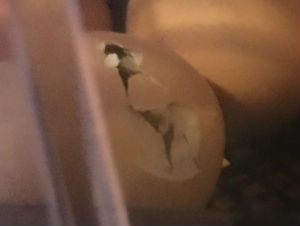 Progress yesterday was slow, so when I woke up at 1 a.m. this morning, I made a beeline to the incubator to see if any of the pipped eggs had zipped. None had, though a couple had enlarged the initial pip so I could see little beaks moving inside and hear chirping.
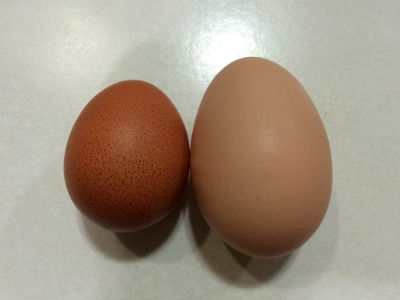 Most people probably don’t spend much time marveling at how chickens come to be. You know a chicken comes out of an egg, but have you wondered how an egg forms inside a chicken? Have you seen double-yolked eggs, or maybe even triple-yolked eggs, and wondered how that happens?
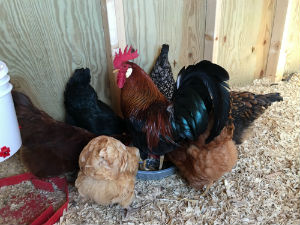 The chickens seem resigned to their current state of confinement to the coop. Since there’s only 7 of them, it’s pretty roomy. It won’t be like that for too long, though – batch 1 of the second generation chicks will be out there in a few weeks.