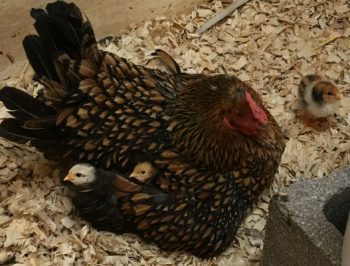
 Goldie’s trio of chicks is happy and healthy, and a week old today. It’s been so interesting watching her raise these little ones: she showed them where to eat and drink, patiently laying by the food dish and clucking to them; she led them in scratching around in the shavings in the brooder (we took pity on them after watching their determined, but fruitless, efforts for a while and scattered some dry chick food around so they could actually “find” something – they have free access to mash); and provided a safe place for the chicks to hide and sleep. She talks to them constantly, with reassuring, encouraging, or warning clucks. There’s a lot of conversation going on in the brooder! Continue reading “Goldie’s Chicks Are A Week Old”
Author: Carrie
A Surprise In A Pullet Egg
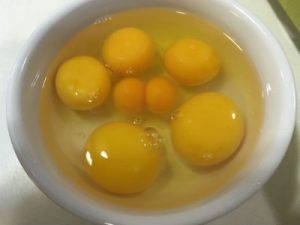 We opened one of the pullet eggs this morning and discovered that it was actually a double-yolker! It’s not uncommon for pullets to lay a few double-yolked eggs initially, but this was a perfect miniature.
Once the pullet’s system works out the kinks, she should just lay regular-sized eggs with single yolks. Single-yolked eggs are desirable for hatching (multiple yolked eggs are difficult, at best, to hatch), and a “normal” egg is easier on the hen, too; sometimes double-yolked eggs are huge. Enough said.
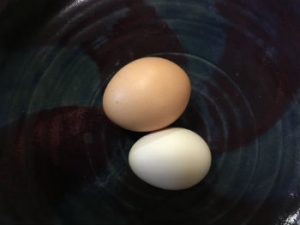 Photo 1 shows three regular chicken eggs, two duck eggs, and the twin yolks of the pullet egg in the center of the bowl. Photo 2 is a comparison of pullet egg to (standard) hen egg.
Goldie’s Hatch – Final Count
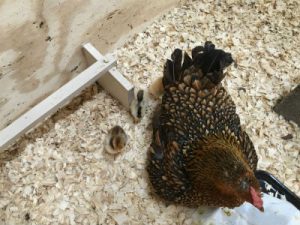 Goldie left the nest with the three unhatched eggs in it yesterday and took her three chicks to the opposite end of the brooder. We took this as a sign that she knew the remaining eggs weren’t going to hatch, so we took them out. Not wanting to risk tossing a viable egg, and to try to better understand why they didn’t hatch, we decided to open them. Carefully. Outdoors.
Candling showed dark interiors in the eggs, but we heard no movement or tapping, and none had pipped…bad signs. Continue reading “Goldie’s Hatch – Final Count”
Goldie’s Eggs Hatch
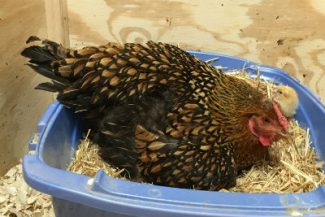 Our Gold Laced Wyandotte, Goldie, has been sitting on a clutch of six eggs for the past three weeks. Today, her hard work and dedication has paid off…she has chicks!
It all began about a month ago, when we noticed that she wouldn’t get out of the nest box. That wasn’t a problem because we could still take eggs from under her. Then we noticed that she had denuded herself – it was startling because the bare skin on her underside looked like an injury at first. Once we figured out what was really going on, and that she seemed intent on brooding, we added five other freshly-laid eggs to the single egg she was sitting on. We kept the number low on purpose; broody hens can randomly decide they’re done being cooped up in a nest box and abandon eggs, so we figured we’d only lose six if she did that…and at about a week in, it looked like she had, indeed, abandoned her eggs. Continue reading “Goldie’s Eggs Hatch”
Today’s Really Weird Egg
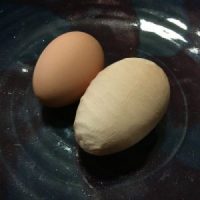 We’re still finding shell-less and soft-shelled (rubber) eggs, eggs smashed from dropping onto the poop board (like they just fell out of the roosting hens) and, today, a very strange-looking egg.
Check out the photo of the egg – it’s larger than average (“normal” egg shown for comparison), and wrinkly. There are many possible reasons for a hen to lay an egg that looks like this, but at this point, it just seems like a pullet’s reproductive system is working out the kinks. The size of the egg suggests it may be a double-yolker – we’ll know soon enough. With the pullets now reaching egg-laying age, there will definitely be more egg oddities!
Ava’s Second Litter – Day Three
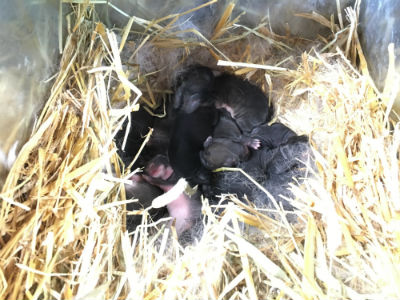 Our red-eyed white (REW) New Zealand doe, Ava, kindled on Sunday. She tends to pull fur at the last minute, so we knew something was up when we saw the nest box lined with white fur. The kits were completely hidden from sight, but slight movement beneath the fur indicated the babies had arrived.
In preparation for kindling, Ava made a very plush nest in the tractor outside – it was thickly padded with grass she had industriously collected and spread inside her tote bin shelter. While it was a shame to waste her efforts, we brought her inside a few days before she was due to kindle and provided her with an equally cushy nest box, which she proceeded to rearrange. Doe’s prerogative. Continue reading “Ava’s Second Litter – Day Three”