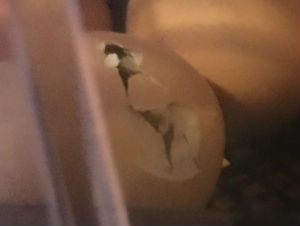
 Progress yesterday was slow, so when I woke up at 1 a.m. this morning, I made a beeline to the incubator to see if any of the pipped eggs had zipped. None had, though a couple had enlarged the initial pip so I could see little beaks moving inside and hear chirping.
When I checked the relative humidity (RH), I was horrified – it was down to 31%, which is far too low for hatching (ideally, it should be more like 65%+, so chicks can successfully exit the shell). It had been holding steady at around 63% since lockdown. Prevailing incubation wisdom dictates that you do everything possible not to open the incubator after lockdown to avoid losing humidity, but I decided that it was worth the risk to add more water to bring up the RH. Chicks have difficulty getting themselves out of a shell with a hardened membrane, so this was potentially a life or death situation.
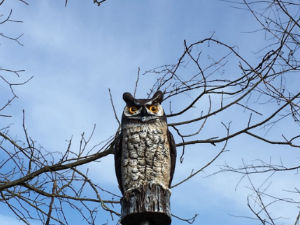 We spent the weekend putting up hawk deterrents to try to discourage the hawk from continuing to attack our chickens. The reflective mylar tape was very flashy with its prismatic print, and we cut “tails” into it to make it even more annoying and distracting. The tape lengths we tied onto the lines rustled and spun in the breeze. We also added DVDs tied onto lines throughout the streambed area, and they spun and flashed, too. Finally, the glowering owl was added on a tall pole. Hopefully, it sends the message “hawks stay away”!
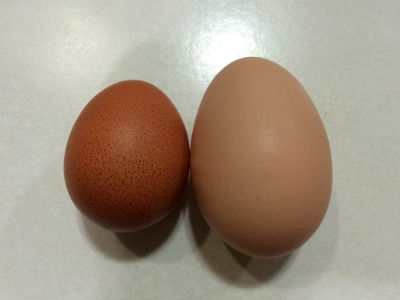 Most people probably don’t spend much time marveling at how chickens come to be. You know a chicken comes out of an egg, but have you wondered how an egg forms inside a chicken? Have you seen double-yolked eggs, or maybe even triple-yolked eggs, and wondered how that happens?
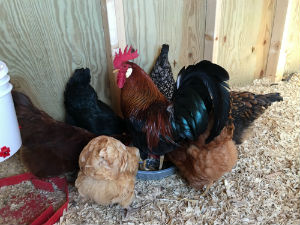 The chickens seem resigned to their current state of confinement to the coop. Since there’s only 7 of them, it’s pretty roomy. It won’t be like that for too long, though – batch 1 of the second generation chicks will be out there in a few weeks.